What it takes to get twenty years out of a tankless heater
A tankless water heater is sold on a twenty-year life, and that single number is what makes its economics work. Whether a particular one reaches it comes down to what is dissolved in the water running through it — and the manufacturers publish exactly what they will and will not tolerate.
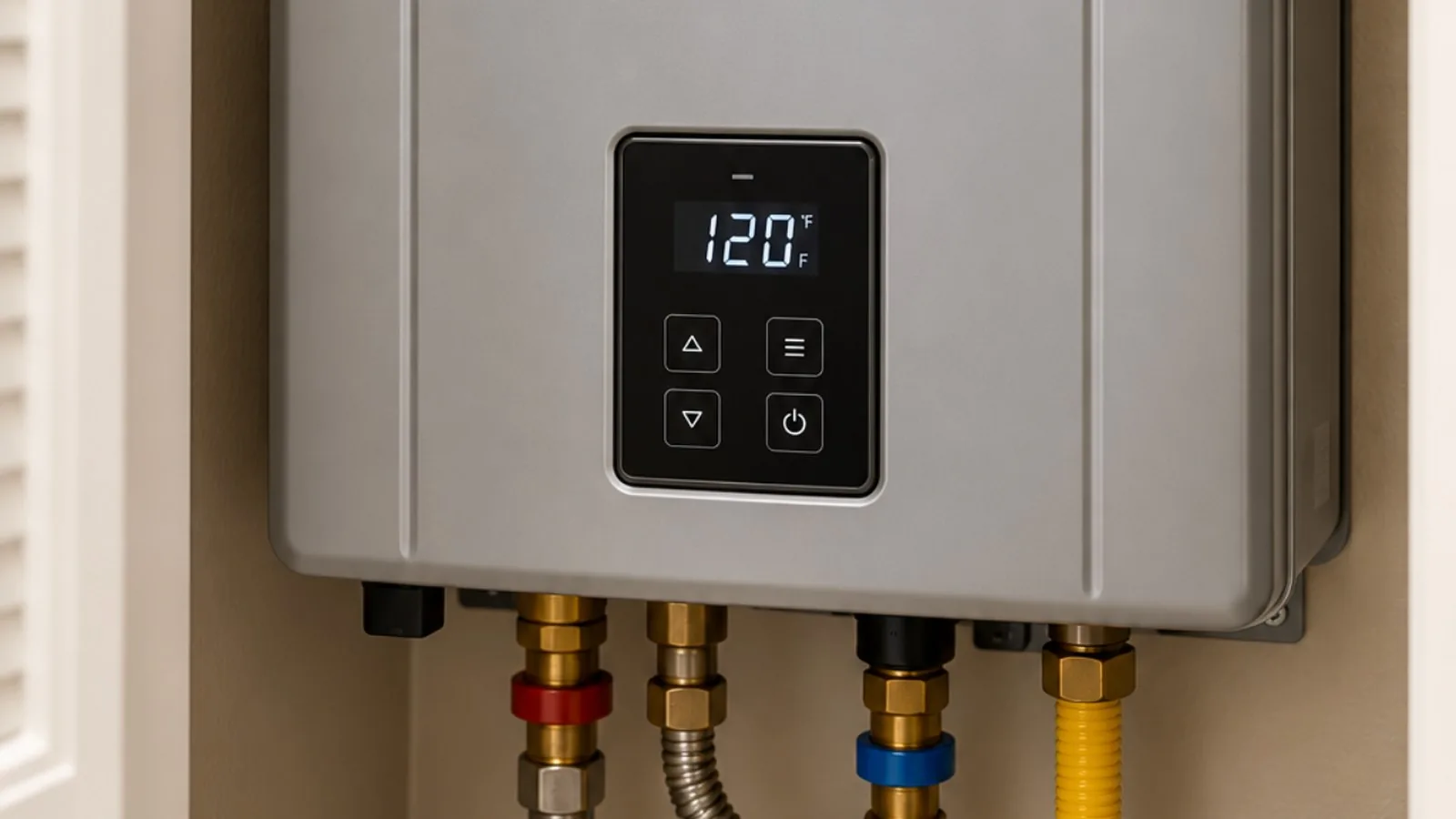
Every tankless water heater is sold on a number. ENERGY STAR puts it plainly: a life expectancy of twenty years, much longer than any conventional tank-type water heater. That single figure is what makes the arithmetic work. A certified gas tankless unit saves a family of four about $95 a year against a gas storage heater — $1,800 over its lifetime — and much of that is lost if the unit does not reach year twenty.
So the interesting question is not whether tankless heaters are efficient. They are, and the certification data is public. The interesting question is what decides whether a particular one in a particular house actually lasts two decades, because that is where the whole case either holds up or quietly collapses.
The answer, almost everywhere, comes down to what is dissolved in the water running through it.
Why a tankless heater and a tank heater fail differently
Start with what is actually happening. Heat drives dissolved calcium out of solution and onto the hot surface. Randy Oshiro of Noritz describes it simply: scale forms when the heat energy inside the heater separates calcium from water.
Here is the part that gets misreported. Noritz is explicit that this same process occurs in both storage tanks and tankless units, with severity depending on local hardness. Tankless heaters are not magnets for scale. What differs is not how much forms — it is where it lands and what it does when it gets there.
In a storage tank, calcium settles to the bottom of a large vessel. It insulates the burner from the water above it and it costs you efficiency, but there is a lot of room down there, and a tank can carry a surprising amount of sediment before anything stops working.
A tankless heater has no such room. Its heat exchanger is a narrow waterway designed to move heat into a thin, fast-moving stream of water. Deposit calcium on those walls and you do two things at once: you insulate the exact surface the whole design depends on, and you narrow the passage the water has to get through. The same quantity of scale that a tank would shrug off is, in a heat exchanger, sitting in the one place it can do the most work.
That is the mechanism. Now the numbers.
The study everyone quotes, and what it actually says
There is one figure that turns up in nearly every article written about this, and it is dramatic. In a 2009 research project conducted with the Battelle Memorial Institute, instantaneous gas water heaters running on softened water held their original factory efficiency rating across a fifteen-year equivalent lifetime. The same heaters running on water at 26 grains per gallon completely failed to function after 1.6 years of equivalent hot water use, as scale plugged the downstream plumbing.
Twenty years of expected life, gone in under two. It is a striking result and it is worth taking seriously.
It is also worth reading carefully, and two things deserve saying out loud.
The first is funding. That study was paid for by the Water Quality Research Foundation — the research arm of the water treatment industry. That does not make the finding wrong, and the underlying chemistry is not controversial. But a study funded by an industry that sells the remedy is a study to corroborate rather than simply repeat, which is why the independent work further down this page matters.
The second is the water. Twenty-six grains per gallon is roughly 445 milligrams per litre. That is very hard water by any measure, and it is not what comes out of the tap in most of this metro.
What the manufacturers actually require
Rather than rely on any study, you can read what the people who build these things write in their own installation manuals — the documents that govern whether a warranty claim gets paid.
Rinnai's N Series residential condensing manual sets out its water quality guidelines in a table. Total hardness: up to 200 mg/L. Total dissolved solids: up to 500 mg/L. Chlorides: up to 250 mg/L. Iron: up to 0.3 mg/L. pH: between 6.5 and 8.5.
Set Tulsa against that. The City of Tulsa publishes hardness by treatment plant, and the two are not close. A.B. Jewell runs 8.2 grains per gallon — 140 mg/L. Mohawk runs 5.2 grains, or 89 mg/L.
Both Tulsa plants are comfortably inside the specification. If you were expecting this article to tell you that Tulsa water will wreck a tankless heater in two years, it will not, because the published figures do not support it.
What they support is something more useful, and it starts a few lines above that table in the same section of the manual.
Curious how your own tap compares? Book a free water walkthrough and we will test the water at your sink.
Inside the spec is not the same as protected
Three things sit behind that conclusion, and each is worth understanding on its own.
The warranty says what it says. Rinnai's manual states it in one sentence: replacement of components due to water quality damage is not covered by the warranty. There is no hardness threshold attached to that sentence. It is not a clause that activates above 200 mg/L — it describes the whole category. Being inside the guideline is what keeps the rest of the warranty intact. It is not a promise that the water will never cost you a heat exchanger.
Scale is a rate, not a threshold. This is the one that gets lost. Nothing special happens at 200 mg/L; calcium does not agree to stay in solution below a line in a table. At 140 mg/L you are still depositing calcium on that heat exchanger every time the burner fires — more slowly than at 445, and relentlessly. The 2009 Battelle study found scale cut the efficiency of gas storage heaters by as much as 24 percent — on 30-grain water, far harder than Tulsa's. That is not a failure. It is a tax, collected quietly, on a machine whose entire economic case rests on a twenty-year run and $1,800 of lifetime savings.
Rinnai's manual also notes that scale build-up can be accelerated if the water heater is set at a high temperature — which means the rate is partly yours to set.
Hardness is one of ten numbers, and often not the binding one. Look again at that table: alongside hardness 200 sit TDS 500, chlorides 250, iron 0.3, pH 6.5 to 8.5 and five more metals and gases. Hardness gets all the attention because it is the one people can see on a shower door. Iron at 0.3 mg/L is the limit that many private wells in Green Country can exceed, and no amount of being inside the hardness guideline helps you there.
Then there is the requirement that is not a number at all. The manual says the supply must be free of corrosive chemicals, sand, dirt, or other contaminants, directs the installer to confirm the heater's own water filter is clean and fitted, and states flatly that debris will damage the water heater. For a house on a well, or on a street where a main was recently replaced, that sentence is doing more work than the hardness line above it.
What demonstrably works
This is where filtration and a tankless heater stop being two separate purchases and start being one system, because each stage maps onto a specific line in that table.
Sediment, first in line. The cheapest protection on the list, and the one the manual asks for in plain words. Particulate does not slowly tax a heat exchanger the way calcium does — it scores surfaces, lodges in narrow passages and fouls the inlet screen. A sediment stage ahead of the heater addresses the failure the manual says outright will damage the heater.
Scale control, and the independent numbers behind it. The ASU work is the most useful evidence here because of how it was run: the German DVGW-W512 protocol, a twenty-one-day test in heating baths, on Tempe tap water measured at 180 mg/L hardness — water harder than either Tulsa plant and still inside Rinnai's guideline. Afterwards the scale was dissolved off the heating element with acid and its calcium measured.
Template-assisted crystallization reduced scale by 96 percent at 80°C and 97 percent at 60°C against untreated water. The protocol's pass mark is 80 percent.
Those are large numbers, and the study was candid about what did not clear the bar. Capacitive deionization reached 83 percent. Electrically induced precipitation managed 50 percent at 80°C and 44 percent at 60°C. Magnetic treatment came in at 43 and 47 percent, and the authors concluded its mechanism needs further study — a finding worth remembering next time a device promises to fix hard water with a magnet.
Carbon, which the manufacturers quietly agree about. The most telling evidence here is not an independent study at all — it is what the heater companies offer alongside their own heaters. Navien's PeakFlow X, specified as a five-stage whole-house unit, combines scale prevention with activated carbon for chlorine, chloramines and particulates, and the company is explicit that the media is not designed for grain removal. The point is not softening. The point is that the firm building the heater put carbon and scale control in front of it on purpose. Rinnai does the same thing with its own ScaleCutter accessory, described in the manual as filtering and reducing the scale entering the heater.
And the annual flush, regardless. Rinnai's guidance is to flush mineral deposits at least once a year. Noritz recommends a check at the one-year mark, descaling annually if a plumber finds significant build-up and stretching the interval if not — and some of its models now carry scale-detection software that watches heat transfer and asks for a descale when it slows. Rinnai's manual describes a comparable service indicator that can be switched on in the settings.
Filtration does not retire that job. What it changes is what the plumber finds when the hour comes, and how much of the twenty years is still ahead of you when they leave.
The twenty-year number is real. It is also conditional.
Put the evidence together and a consistent picture emerges, and it is a more encouraging one than the scare version.
Tulsa is not Phoenix and it is not the Battelle test bench. Both city plants deliver water inside the published manufacturer guideline, and a tankless heater installed here is not on a 1.6-year clock. That is genuinely good news, and anyone who tells you otherwise is selling from a study run on water more than twice as hard as yours.
What is equally true is that the twenty-year figure is a maintained outcome rather than a default one. The manufacturers say so themselves, in the same documents that set the limits: treat the water where it is hard, keep debris out, watch the set point, flush it once a year. Every one of those instructions is about the same thing — holding the heat exchanger in the condition it left the factory in, for as long as possible.
That is the part worth taking away. A tankless heater is one of the few appliances in a house whose working life is genuinely in the owner's hands, and the levers are known, measured and published. Sediment filtration handles the damage the manual warns about. Scale control has independent test data behind it at 96 to 97 percent. Carbon is what the heater manufacturers themselves put upstream. None of it is exotic, none of it is guesswork, and all of it is aimed at the same twenty-year number the heater was sold on in the first place.
Buy the efficiency, by all means. Then protect the thing that delivers it.
Sources
- ENERGY STAR — Gas tankless water heaters, benefits and savings
- Rinnai — N Series Residential Condensing Installation and Operation Manual (water quality guidelines, Table 5)
- Rinnai — Flushing your tankless water heater
- Noritz — Understanding scale deposits in your tankless water heater
- Navien — PeakFlow X filtration system specification
- Fox, Wiest (Arizona State University) and Thomure, Lee (HDR) — Evaluation of Alternatives to Domestic Ion Exchange Water Softeners, final report (WateReuse Research Foundation, 2014)
- Wiest, Fox (Arizona State University) and Lee, Thomure (HDR) — Evaluation of Alternatives to Domestic Ion Exchange Water Softeners, interim results, 2011
- Battelle Memorial Institute / Water Quality Research Foundation — Softened water benefits study findings, 2009
- City of Tulsa — Annual Water Quality Report
- City of Tulsa — FAQs about water (hardness by treatment plant)
Every figure in this article comes from the published sources listed above. This is general information, not advice about the water at any particular address.